
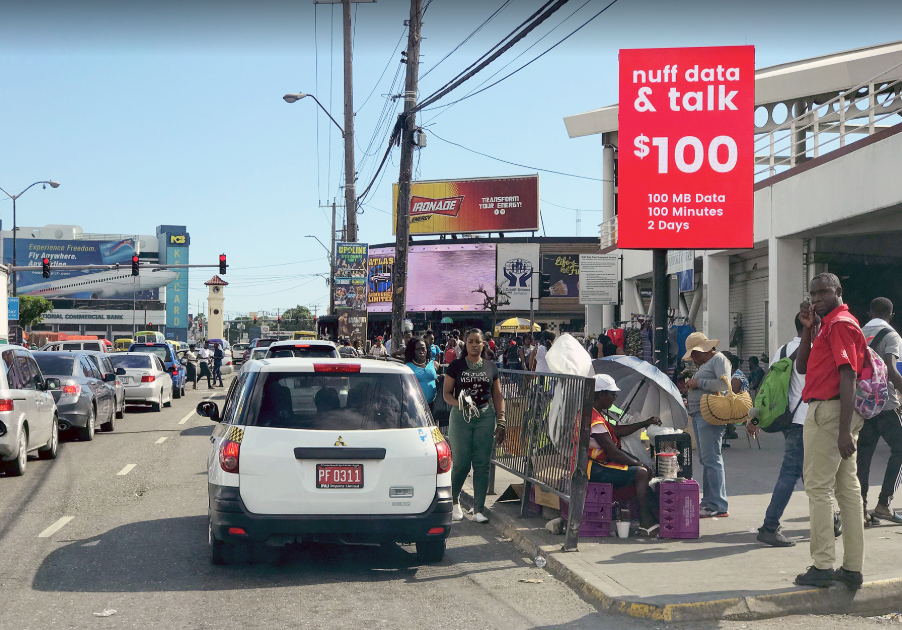
A comprehensive guide to erecting outdoor billboards in Jamaica
A complete roadmap for legally erecting traditional and LED digital billboards — from site selection through final inspection and ongoing compliance.
reference
edition
Outdoor advertising — particularly LED digital billboards — is experiencing rapid growth across Jamaica, offering brands exceptional visibility on busy roads and commercial corridors. Billboard installation is a highly regulated activity requiring careful planning, multiple approvals, and strict compliance with local and national regulations.
Understanding the regulatory framework
Primary regulatory bodies
Municipal Corporations handle billboard control under planning and building regulations, including:
- Kingston and St. Andrew Municipal Corporation (KSAMC) — for Kingston and St. Andrew
- St. Ann Municipal Corporation — for St. Ann Parish
- St. James Municipal Corporation — for St. James Parish
- Similar corporations for each parish across Jamaica
Municipal Corporations approve outdoor signs, billboards, and advertising structures under their jurisdiction.
National Works Agency (NWA) becomes involved when billboards are located:
- Near or visible from main roads or highways
- Where road safety, driver sightlines, or setbacks may be affected
- On or encroaching upon road reserves
Other relevant agencies: National Environment and Planning Agency (NEPA), Jamaica Fire Brigade, National Water Commission (NWC), Ministry of Health (Environmental Health Unit).
Governing legislation
- Building Act
- Town and Country Planning Act 1957 (Amended 1999)
- Local Improvement Act
- Local Authority Act
- Jamaica Building Code
Securing the billboard site
Before applying for any approvals, you must secure legal rights to the location.
Site selection criteria
Avoid locations that
- Obstruct intersections or pedestrian crossings
- Impair driver visibility or road safety
- Violate setback requirements from roadways
- Fall within restricted zones (schools, churches, government buildings)
- Encroach on utilities or infrastructure
Prioritize sites with
- High traffic volume and visibility
- Stable ground conditions for foundations
- Access to electrical power supply
- Adequate setback from road edges
- Compatible zoning for commercial advertising
Landowner agreement
Secure written permission or a lease agreement from the property owner that clearly defines:
- Duration of use — term of the lease or license
- Access rights — for installation, maintenance, and repairs
- Power supply responsibilities — who pays for electricity
- Maintenance obligations — ongoing upkeep duties
- Liability and insurance — who bears responsibility for incidents
- Rental or license fees — payment terms
- Termination clauses — exit conditions
Required property documentation
- Certified copy of land title from National Land Agency (no more than 30 days old)
- Current property tax certificate for the site
- If you're not the landowner: letter of authorization, stamped and signed by a Justice of the Peace or Notary Public
Preparing your technical package
A compliant application depends on a permit-ready design package prepared by qualified professionals.
3.1 Site plan and location sketch
Provide a comprehensive site plan showing:
- Billboard position relative to roads, sidewalks, and neighbouring properties
- All existing signs and structures in the vicinity
- Distance measurements to property boundaries
- Road frontage and setback distances
- Utilities and infrastructure (power lines, water mains, etc.)
- Scale — minimum 1:500
3.2 Detailed billboard drawings
Front and side elevations showing:
- Overall height from ground level
- Ground clearance beneath the structure
- Screen/display dimensions (for LED billboards)
- Support column specifications
- Material specifications
- Scale — minimum 1:100
Standard billboard sizes: Tri-media 21ft × 10ft or 32ft × 10ft; billboards 21ft × 10ft or 32ft × 10ft. Custom sizes must be clearly justified.
3.3 Structural details — critical for safety
Foundation design:
- Foundation plan showing all structural members
- Footing dimensions and depth
- Concrete specifications and reinforcement
- Soil bearing capacity analysis
- Foundation details including support columns
Support structure:
- Steel support framework specifications
- Connection details and fasteners
- Anti-corrosion treatment
- Wind-load calculations and considerations
- Seismic resistance (where applicable)
Engineering requirements
- Structural calculations — 9 copies required
- All structural drawings must be stamped/sealed by a registered engineer
- Engineer's certification of compliance with the Jamaica Building Code
3.4 Electrical and safety plan — essential for LED billboards
Power supply details:
- Power source identification
- Electrical load calculations
- Cabling route from source to billboard
- Cable specifications and protection
- Isolation switch location and specifications
- Grounding/earthing system
- Cabinet access and security
Safety features:
- Emergency shutdown provisions
- Lightning protection
- Weatherproofing measures
- Fire safety considerations
- Maintenance access safety
Applying for municipal approval
All billboards require formal approval from the relevant Municipal Corporation before construction begins — this is mandatory.
4.1 Application submission
KSAMC — Kingston & St. Andrew
24 Church Street, Kingston, Jamaica
(876) 967-0585 / 967-4195
Track via AMANDA: ksamc.gov.jm or jdap.gov.jm
Other parishes
Contact your local Municipal Corporation office for specific procedures.
4.2 Required documents
- Completed application form — 4 copies for outdoor advertising/sign permit
- Encroachment application form (if sign encroaches on government property)
- Tax Registration Number (TRN) and business registration
- Site plan and technical drawings (Section 03)
- Structural calculations and engineer's certification
- Landowner consent or lease agreement
- Proof of land ownership (certified title)
- Current property tax certificate
- Trade License from Tax Administration of Jamaica (TAJ)
- Payment of application fees
4.3 Fee structure — KSAMC current rates
| Structure type | Fee |
|---|---|
| LED board | $4,055 JMD + building & inspection fee |
| Traditional billboard | $364.50 JMD per display side + building & inspection fee |
| Wall mural / painting | $364.50 JMD per display side + inspection fee |
| Inspection fee | ~$2,000 JMD |
| Building permit fees | Based on structure size and complexity |
Fees vary by parish — check with your local Municipal Corporation for current rates.
4.4 Review and approval timeline
- Application validation and assignment of reference number
- Site inspection by Municipal Corporation officers
- Review by Physical Planning & Development Committee (meets monthly, typically first Wednesday)
- Possible referrals to other agencies (NWA, NEPA, Fire Brigade, etc.)
- Approval decision communicated
Minimum turnaround
5 days for straightforward applications
Standard processing
Approximately 1 month
Complex applications
2–3 months, depending on consultations required
Committee review
Larger billboards typically trigger committee review, decided monthly
Additional approvals for main roads & highways
If your billboard is located along a main road, highway, or within a road reserve, additional requirements apply.
5.1 National Works Agency (NWA) clearance
When NWA involvement is required:
- Billboard visible from major highways or main roads
- Structure located within or near road reserves
- Potential impact on traffic flow or driver safety
NWA considerations:
- Setback distances — minimum distance from road edge, varies by road classification
- Driver sightlines — no obstruction of critical sight triangles at intersections
- Road safety — assessment of distraction risk to motorists
- Structural proximity — clearance from road infrastructure
Application process: the Municipal Corporation may require NWA written clearance before final approval. NWA may impose specific conditions (height restrictions, setback requirements, etc.). Special encroachment fees may apply for road reserve use.
5.2 Road reserve encroachment
If the billboard encroaches on government-owned road reserve:
- Submit encroachment application alongside billboard permit
- Pay encroachment fees (annually renewable)
- Obtain formal encroachment permit
- Comply with any special conditions imposed
Building and structural approval
Beyond advertising consent, most billboards — especially LED structures — also require separate building or structural approval, a dual-track process.
6.1 When building approval is required
- Large steel structures or substantial concrete foundations
- Billboards exceeding standard sign dimensions
- Any structure requiring significant engineering
- LED billboards with heavy electrical installations
- Coastal or high-wind areas with enhanced structural requirements
6.2 Building permit application
May be submitted concurrently with the advertising permit. Requires the same structural drawings and engineer certifications. The Building Department conducts a separate technical review focused on structural integrity and public safety, covering compliance with the Jamaica Building Code, wind-load resistance, foundation adequacy, seismic considerations, and material specifications.
6.3 Permit validity and revalidation
Construction timeframe
Construction must commence within 6 months of permit issuance, or the permit lapses.
Revalidation
Available for 10% of the original fee. Maximum 4 revalidations allowed (2 years total) — after that, a new application is required.
Installation and construction phase
Once all approvals are secured, construction can proceed.
7.1 Pre-construction requirements
- Keep all approved plans and permits on site during construction
- Engage licensed contractors with relevant experience
- Ensure materials match specifications in approved drawings
- Notify Municipal Corporation of construction commencement
7.2 Installation steps
- Site excavation and preparation
- Soil testing and compaction
- Formwork and reinforcement placement
- Concrete pouring and curing
- Foundation inspection (if required)
- Steel column installation and anchoring
- Framework assembly and welding
- Structure alignment and leveling
- Anti-corrosion treatment application
- Structural inspection
- Screen panel mounting
- Electrical cabinet installation
- Power connection and testing
- Control system setup and commissioning
- Weatherproofing and sealing
- Electrical safety inspection
- Grounding system verification
- Access provisions for maintenance
- Site cleanup and landscaping
7.3 Inspections
During construction: foundation inspection (before concrete pour), structural framing inspection, electrical rough-in inspection.
Final inspection confirms installation matches approved drawings, verifies the structure does not obstruct roads or pedestrian areas, ensures electrical safety compliance, and the Municipal Corporation issues final sign-off.
Do not begin operation early
Do not commence operation until the final inspection is approved.
Ongoing compliance and operation
After installation, ongoing obligations ensure continued legal operation.
8.1 Annual compliance requirements
Renewals and fees:
- Pay annual billboard fees to Municipal Corporation (recurring)
- Renew encroachment permits (if applicable)
- Update Trade License annually
- Maintain current property tax payments
Structural maintenance:
- Regular inspections of structural integrity
- Rust and corrosion prevention
- Foundation monitoring
- Wind damage assessment after storms
Electrical maintenance — LED billboards:
- Regular electrical system checks
- Power supply continuity
- Grounding system maintenance
- Control system updates
8.2 Content compliance
Ensure displayed advertising content complies with local advertising standards and decency regulations, copyright and intellectual property laws, truth in advertising requirements, and any specific content restrictions in permit conditions.
8.3 Record keeping
Maintain on file
- All approval documents and permits
- Structural engineer's certifications
- Electrical inspection certificates
- Maintenance logs
- Insurance documentation
- Lease or landowner agreements
Enforcement reality
The majority of signs erected in Kingston have not received proper approval from the KSAMC. Authorities are actively conducting audits and enforcement actions, so proper compliance is essential to avoid penalties.
Penalties for non-compliance
Building or operating without proper permits carries severe consequences.
9.1 Building without a permit
Enforcement actions: a Stop Notice requires immediate cessation of construction; an Enforcement Notice is a formal legal notice requiring compliance; unauthorized structures may face a demolition order.
Financial penalties
- Fine of up to $1,000,000 JMD under the Town and Country Planning Act if notices are disobeyed
- Additional fine of $5,000 JMD per day if development continues
- Fine of not less than $250,000 JMD under the Jamaica Building Code
- Doubled fees if building in breach and plans submitted after the fact
- Signage at risk of being taken down for non-payment
Criminal penalties: possible property forfeiture to the Crown upon conviction, and a criminal record for repeat or serious violations.
9.2 Operating without renewal
- Accumulated arrears with interest
- Legal action by Municipal Corporation
- Removal of billboard structure
- Loss of investment
Professional services required
Successful billboard projects require qualified professionals.
10.1 Essential consultants
Registered structural engineer
Foundation and structural design
Wind-load and seismic calculations
Stamped/sealed drawings and certifications
Compliance with Jamaica Building Code
Licensed land surveyor
Site survey and measurements
Boundary verification
Topographic survey if required
Architect / draughtsman
Technical drawing preparation
Design coordination
Application package assembly
Licensed electrical engineer
For LED billboards
Electrical system design
Power calculations
Safety system specifications
Licensed contractor
Foundation and structural construction
LED installation and commissioning
Quality control and site management
10.2 Selecting professionals
- Verify registration with relevant professional bodies
- Check experience with similar billboard projects
- Request references from previous clients
- Ensure adequate insurance coverage
Step-by-step process summary
- Identify suitable location
- Conduct site assessment
- Negotiate with landowner
- Secure lease or permission agreement
- Obtain property documentation
- Engage structural engineer
- Develop site plan and drawings
- Complete structural calculations
- Prepare electrical plans (LED billboards)
- Compile complete technical package
- Submit application to Municipal Corporation
- Pay application fees
- Undergo site inspection
- Await committee review
- Obtain NWA clearance (if required)
- Receive building permit
- Receive advertising permit
- Engage licensed contractor
- Construct foundation
- Erect support structure
- Install LED cabinet (if applicable)
- Complete electrical connections
- Conduct safety inspections
- Schedule final inspection
- Receive final sign-off
- Commence operations
- Establish maintenance schedule
- Ensure annual renewals
Total timeline: 6–9 months from site selection to operation, varying by complexity and approvals.
Quick reference checklist
Before you apply
Application package
During construction
After installation
Ongoing compliance
Key tips for success
The approval process can take 6+ months — plan accordingly.
Use registered engineers, architects, and licensed contractors with billboard experience.
Incomplete applications cause significant delays and may be rejected.
Maintain regular contact with the Municipal Corporation throughout the process.
Account for professional fees, application and permit fees, construction costs, annual renewal fees, ongoing maintenance, and insurance.
Keep all permits, approvals, payment receipts, and correspondence.
If near main roads, factor in additional time and possible conditions.
Building without permits results in severe penalties and possible demolition.
Experienced operators understand the process and have established relationships with authorities.
Ongoing compliance is essential; authorities actively enforce against unauthorized billboards.
Useful contacts and resources
National resources
Jamaica Development Application Portal — jdap.gov.jm
National Works Agency — nwa.gov.jm
NEPA — nepa.gov.jm
Kingston and St. Andrew
KSAMC — ksamc.gov.jm
24 Church Street, Kingston
(876) 967-0585 / 967-4195
Other parishes
St. Ann Municipal Corporation
St. James Municipal Corporation (Montego Bay)
Portland, Manchester, Clarendon and others — contact respective offices
Professional bodies
Jamaica Institution of Engineers (JIE)
Jamaica Institute of Architects (JIA)
Land Surveyors Association of Jamaica
Final considerations
For LED digital billboards specifically
- Higher electrical load requires robust power infrastructure
- Digital permits may have specific content rotation rules
- Brightness levels may be regulated to prevent driver distraction
- Technology must be weatherproof for Jamaica's tropical climate
- Maintenance contracts essential for electronic components
Parish-specific variations
While this guide provides general procedures applicable across Jamaica, specific requirements may vary by parish — application forms may differ slightly, fee structures vary between Municipal Corporations, processing times depend on local committee schedules, and some parishes may have additional local regulations. Always confirm specific requirements with your local Municipal Corporation.
Investment considerations
- Location viability — traffic counts, visibility, competition
- Revenue potential — advertising rates in the area, demand
- Operating costs — electricity, maintenance, annual fees
- Competition — existing billboards in vicinity
- Long-term lease security — stability of landowner relationship
- Exit strategy — ability to relocate or sell if needed
Conclusion
Erecting an outdoor billboard in Jamaica — whether traditional or LED digital — is a structured but entirely achievable process when approached correctly. Success depends on thorough planning, complete documentation, proper approvals secured before construction, quality construction with licensed contractors, and ongoing compliance with annual obligations.
By working closely with your Municipal Corporation, securing necessary clearances from agencies like the NWA, and maintaining strict compliance, you can install a legally compliant, high-impact advertising asset that operates profitably for years to come.
The investment in proper procedures protects your capital investment, avoids costly penalties and demolition orders, and ensures your billboard contributes positively to Jamaica's advertising landscape.
Need help? Consider consulting with established billboard operators or outdoor advertising companies who have experience navigating Jamaica's regulatory environment. Their expertise can save significant time and help avoid costly mistakes.
This guide is for informational purposes only and should not be considered legal advice. Requirements and procedures may change. Always verify current requirements with your local Municipal Corporation and consult qualified professionals for your specific project.