
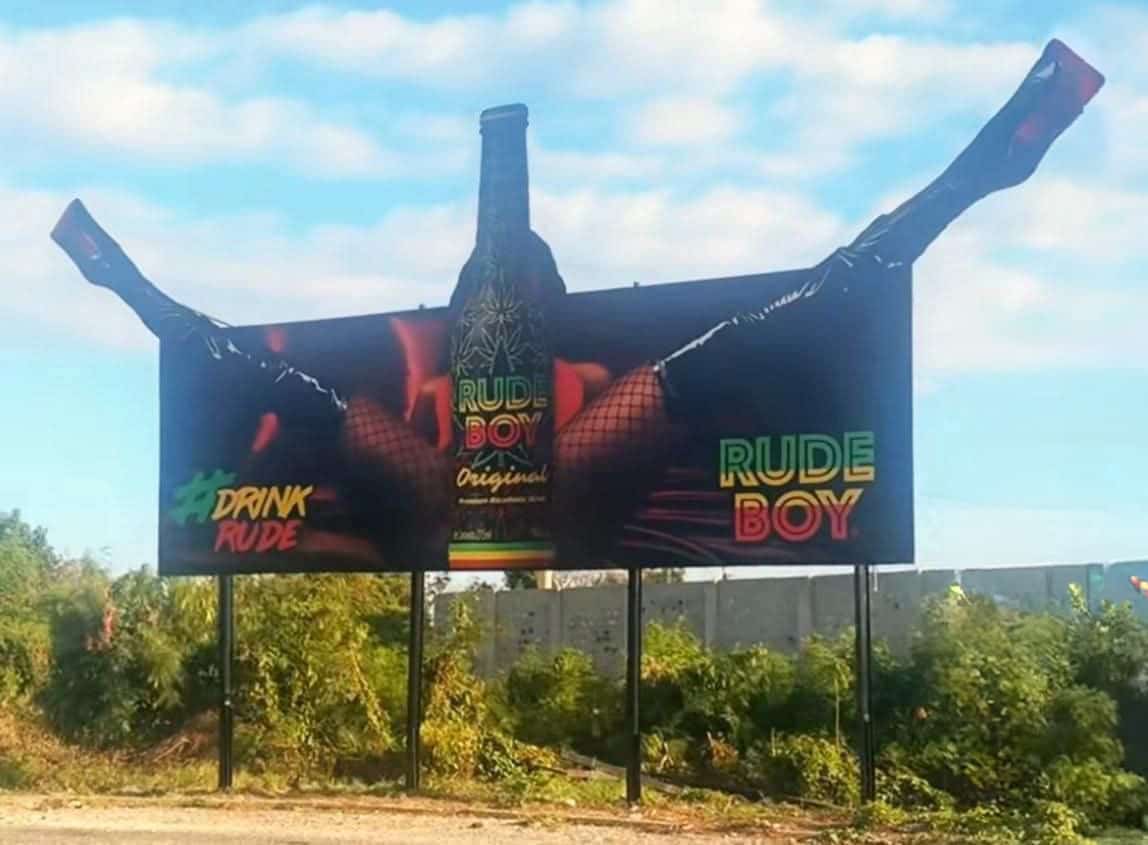
Rude Boy Billboard: Marketing Genius or Disrespect to Jamaicans?
The recent Rude Boy billboard controversy in Jamaica has opened up a much-needed national conversation about the power of outdoor advertising, the limits of shock marketing, and the responsibility brands carry when they place bold messages in public spaces.
The billboard, which promoted Rude Boy Original, reportedly featured a bottle positioned between raised legs wearing black fishnet stockings and high-heeled boots, alongside the slogan “#DrinkRude”. It was displayed in Rockfort, eastern Kingston, and quickly attracted criticism from members of the public who felt the imagery was too sexually suggestive, especially because of concerns about its proximity to a school crossing. The Kingston and St Andrew Municipal Corporation later confirmed that the billboard did not have the required approval and had been erected in a designated sterile area where such installations are not permitted.
Was it marketing genius?
From a pure marketing perspective, the billboard achieved one thing every advertiser wants: attention. People noticed it, shared it, debated it, defended it and criticised it. In that sense, the campaign became more than a billboard; it became a national talking point.
That is the power of outdoor advertising. A billboard sits in public view, cannot be skipped like a YouTube ad, and becomes part of the physical environment. When executed well, it can make a brand unforgettable. The Rude Boy billboard certainly did that.
However, attention alone is not the same as effective brand building. A campaign can go viral for the wrong reasons. If the public remembers the controversy more than the product, the brand may win awareness while losing trust. In Jamaica, where culture, community, family values and public respect still matter deeply, shock value can quickly turn into reputational risk.
Or was it disrespectful?
The strongest criticism was not simply that the billboard was bold. Jamaica is no stranger to dancehall culture, provocative fashion, edgy entertainment or adult humour. The issue was context.
A sexually suggestive alcohol billboard in a public space raises different questions from an adult-themed campaign at a private event or nightclub. Outdoor advertising is seen by everyone: children, parents, churchgoers, commuters, tourists, students and workers. That is why public placement matters as much as creative design.
Kingston Mayor Andrew Swaby stated that the KSAMC is responsible for the approval of sign specifications such as size, placement, structure, location, planning and safety requirements, but not the approval of the actual advertising artwork. He also said advertisers should exercise good judgement and consideration for the wider community.
That distinction is important. A billboard may fail in two ways: it may breach planning requirements, or it may offend public standards. In this case, the controversy appears to have raised both issues.
The deeper issue: alcohol advertising in public spaces
The Rude Boy billboard also highlights a larger question about alcohol advertising in Jamaica. The Jamaica Information Service previously reported that discussions around alcoholic beverage advertising included calls for responsible and cautionary messages, with emphasis on socially responsible advertising.
That matters because alcohol advertising is not the same as advertising a phone, clothing brand or food item. Alcohol is a regulated product, and responsible brands must consider underage exposure, public safety, cultural interpretation and the message being sent.
A billboard saying “Drink Rude” beside sexually suggestive imagery may be clever from a branding standpoint, but it also invites criticism because it links alcohol, sexuality and public provocation in a space where minors and families may be exposed.
What this means for outdoor advertising in Jamaica
For the billboard industry, the lesson is clear: creative freedom must work alongside compliance and cultural awareness.
Billboards in Jamaica require proper approvals from the relevant Municipal Corporation before construction or display. For larger outdoor signs, advertisers may also need to consider structural drawings, engineering certification, planning requirements, road safety and, where applicable, National Works Agency clearance.
The St Catherine Municipal Corporation has now announced plans to establish an ethics committee to guide how billboards are displayed across the parish, following the Rude Boy controversy. According to The Gleaner, the committee is expected to develop clearer policy guidelines around what is advertised and how it is presented.
This could mark a turning point for outdoor advertising in Jamaica. The industry may now face greater scrutiny, not only on whether a sign is structurally approved, but whether the content is appropriate for public display.
The cultural mistake brands must avoid
The term “Rude Boy” has deep roots in Jamaican culture. It is connected to street identity, music, rebellion, fashion and attitude. For some brands, that cultural edge is commercially attractive. But using Jamaican cultural references without sensitivity can easily feel exploitative.
There is a fine line between celebrating Jamaican culture and reducing it to vulgarity, sexuality or shock value. Brands entering the Jamaican market must understand that Jamaica is not just an aesthetic. It is a country with history, values, communities and standards.
A campaign can be bold, youthful and edgy without making the public feel disrespected.
Final verdict: genius or disrespect?
The Rude Boy billboard was undeniably effective at generating attention. In that sense, it was a powerful example of disruptive billboard marketing.
But true marketing genius is not just about being seen. It is about being remembered for the right reasons.
If the campaign had secured the correct approvals, considered its location more carefully, toned down the sexual imagery, and included responsible alcohol messaging, it may have been viewed as edgy and creative rather than offensive and careless.
So, was it marketing genius or disrespect to Jamaicans?
The answer is: it was both a marketing success and a strategic warning.
It proved that billboards still have enormous power in Jamaica. But it also proved that outdoor advertising must respect the public space it occupies. In a country as culturally rich, expressive and community-conscious as Jamaica, the best campaigns are not the ones that simply shock people. They are the ones that command attention while respecting the audience.