
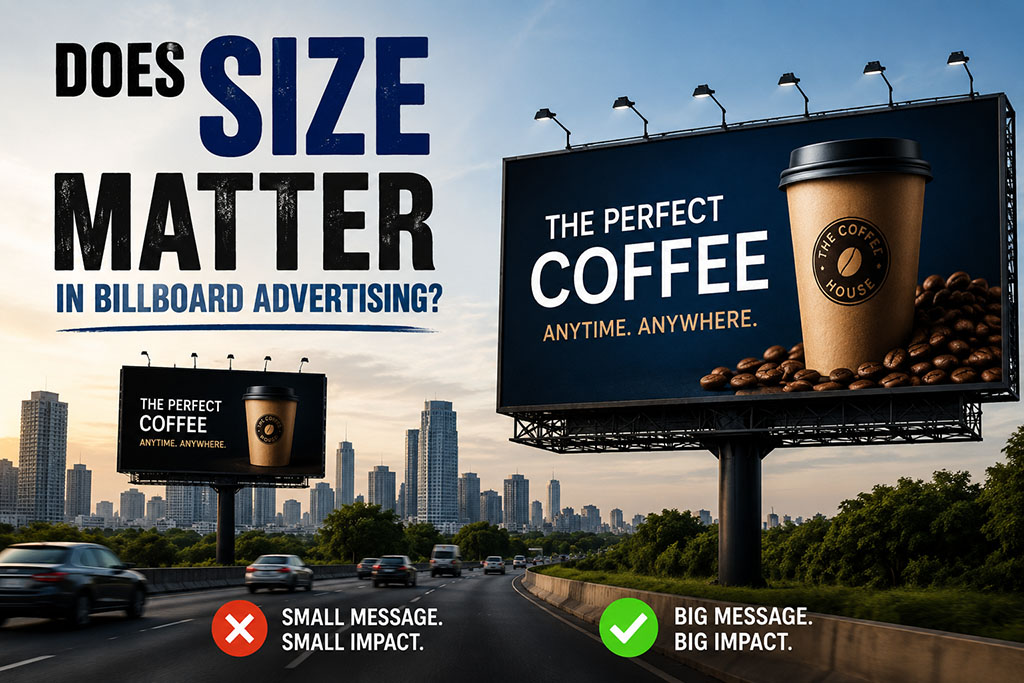
The debate is older than the highway itself — but in today's cluttered media landscape, the answer is more nuanced, and more strategic, than ever before.
By Xplore Media · 2026
Drive down any major highway and the answer seems obvious. The giant bulletin towering above the treeline commands your attention before you even register seeing it. But seasoned advertisers and media planners know that in billboard advertising, size alone is not a strategy — it’s just a starting point.
The out-of-home (OOH) advertising industry has long wrestled with the relationship between physical scale and advertising effectiveness. From the classic 14×48-foot bulletin to the compact 5×11-foot junior poster, each format carries its own set of advantages, trade-offs, and ideal use cases. Understanding these distinctions can mean the difference between a campaign that merely fills space and one that moves product, builds brands, and drives measurable results.
The Anatomy of Billboard Sizes
Billboard formats exist along a wide spectrum, each with distinct characteristics that make them suited for particular environments and objectives. The industry broadly classifies outdoor displays into several key categories.
Each format is a tool, not a verdict. Choosing between them should be driven by campaign objectives, audience behaviour, available budget, and the physical context of the placement — not by the assumption that bigger is automatically better.
The Case for Going Big
There are compelling, well-documented reasons why large-format billboards remain the flagship product of the OOH industry. Sheer scale creates undeniable visual authority. A bulletin placed at a high-traffic interchange can generate hundreds of thousands of daily impressions, with a cost-per-thousand (CPM) that is remarkably competitive against digital and broadcast alternatives.
"A landmark billboard doesn't just carry your message — it becomes part of the landscape. People navigate by it, photograph it, and remember it long after the campaign ends."
Large formats are particularly powerful for brand awareness campaigns where the goal is to saturate a geographic market with a singular, memorable image. Luxury brands, automotive advertisers, and entertainment studios have long understood that a towering presence communicates prestige that a smaller format simply cannot replicate at the same intensity.
Visibility distance is another critical advantage. Highway bulletins are designed to be legible from 500 feet or more, giving drivers adequate time to process the message before passing. This extended viewing window — often four to six seconds — is a luxury that most digital advertising formats never achieve.
When Smaller Wins
The narrative changes dramatically in dense urban environments. Here, the billboard’s relationship with its audience shifts from a fast-moving vehicular encounter to a slower, more intimate pedestrian one. In these contexts, smaller formats — poster panels and junior posters — frequently outperform their larger counterparts on a return-on-investment basis.
Consider a quick-service restaurant promoting a new menu item. A bulletin on the ring road reaches commuters who may be miles from the nearest location. A well-placed poster panel within 300 metres of the restaurant, positioned at eye level on a busy pedestrian street, reaches a consumer who is hungry, nearby, and capable of acting on the message within minutes. This is the power of proximity advertising, and it has nothing to do with square footage.
Smaller formats also enable advertisers to build frequency networks — multiple placements across a target neighbourhood that collectively create the impression of ubiquity. A brand appearing on six poster panels within a defined trade area may generate stronger recall than a single bulletin outside it.
"Reach tells you how many people saw your board. Proximity tells you how many of them could actually do something about it."
The Creative Dimension
Perhaps the most underappreciated factor in the size debate is the role of creative execution. A brilliant design on a mid-sized poster can achieve greater impact than a mediocre concept scaled to bulletin proportions. Billboard creative operates under strict constraints regardless of format: six seconds of attention, a message legible from distance, and a single-minded proposition that requires no explanation.
Large formats reward bold simplicity — a striking image, three to five words of copy, and immediate brand identification. The canvas is enormous, but the effective creative zone is often a fraction of it. Cluttered bulletins are worse than no billboard at all; they confuse the eye and leave no lasting impression.
Smaller formats, by contrast, can accommodate slightly more detail when placed in pedestrian environments where dwell time increases. A transit shelter advertisement on a busy high street may have thirty seconds or more of a commuter’s attention — enough to communicate a genuine value proposition, a price point, or a call to action with a URL or QR code.
The Digital Factor
The rise of digital out-of-home (DOOH) has added a new variable to the size equation. Digital billboards — largely built on bulletin-sized structures — offer something static formats cannot: dynamic content that changes by time of day, day of week, weather conditions, or real-time data triggers.
A single large digital billboard can serve multiple advertisers in rotation, reducing individual costs while maintaining the visual dominance of a large format. For advertisers, this means the premium of a large-format presence becomes more accessible, while the ability to update creative in near real-time transforms the medium from a static announcement into a responsive communications channel.
That said, the shared nature of digital inventory means that no single advertiser owns the location. Frequency of exposure per advertiser is reduced, and the campaign’s effectiveness depends not just on size and placement but on the quality of the message loop and the strategic timing of display windows.
Location Outranks Format — Always
If there is one principle that unifies all perspectives in this debate, it is this: location is the single most important variable in outdoor advertising, and no amount of square footage compensates for poor placement. A spectacular 100-foot superboard on a low-traffic secondary road will deliver fewer impressions — and less business impact — than a modest 30-sheet poster at a premium urban intersection.
The best billboard media strategies combine formats deliberately. Large bulletins establish brand presence and build awareness across a broad geographic footprint. Poster panels extend that presence into specific neighbourhoods and retail trade zones. Junior posters and street furniture deliver the final push at the point of decision, capturing the consumer in the last moments before a purchase choice is made.
This layered approach — sometimes called a “cascade” or “funnel” strategy in OOH planning — mirrors the way effective digital campaigns combine broad-reach display advertising with targeted retargeting. The principle is the same; only the medium differs.
So — Does Size Matter?
Yes. And no. Size matters enormously in the right context: a highway corridor, a landmark intersection, a brand campaign designed to dominate a market. It matters far less in a pedestrian-first urban environment where proximity, dwell time, and contextual relevance drive consumer response.
The more productive question is not “how big?” but “where, for whom, and to what end?” Billboard advertising, at its most effective, is a precision instrument disguised as a blunt one. The scale is visible for miles; the thinking behind it should be equally expansive.
“The best outdoor campaigns don’t just use space — they understand it.”
For advertisers and media owners alike, the mandate is the same: resist the temptation to equate investment with impact, or size with strategy. The billboard that works is not necessarily the largest one on the market — it is the one in the right place, with the right message, reaching the right person at the right moment in their day.
In that sense, size is just the beginning of the conversation.